PRO Series · Note 05
Handle and Trim Damage on Stainless Doors
A loose or bent handle on a PRO says as much about the door as the handle: a front that drags gets pulled harder, and the fixings take the strain. Sub-Zero Appliance Repair Bellevue secures or replaces the handle and finds why it was forced; call (425) 696-2636.
SignedBjorn Aaltonen
- In the trade
- 15 years
- Holds
- EPA 608 certified
- Written
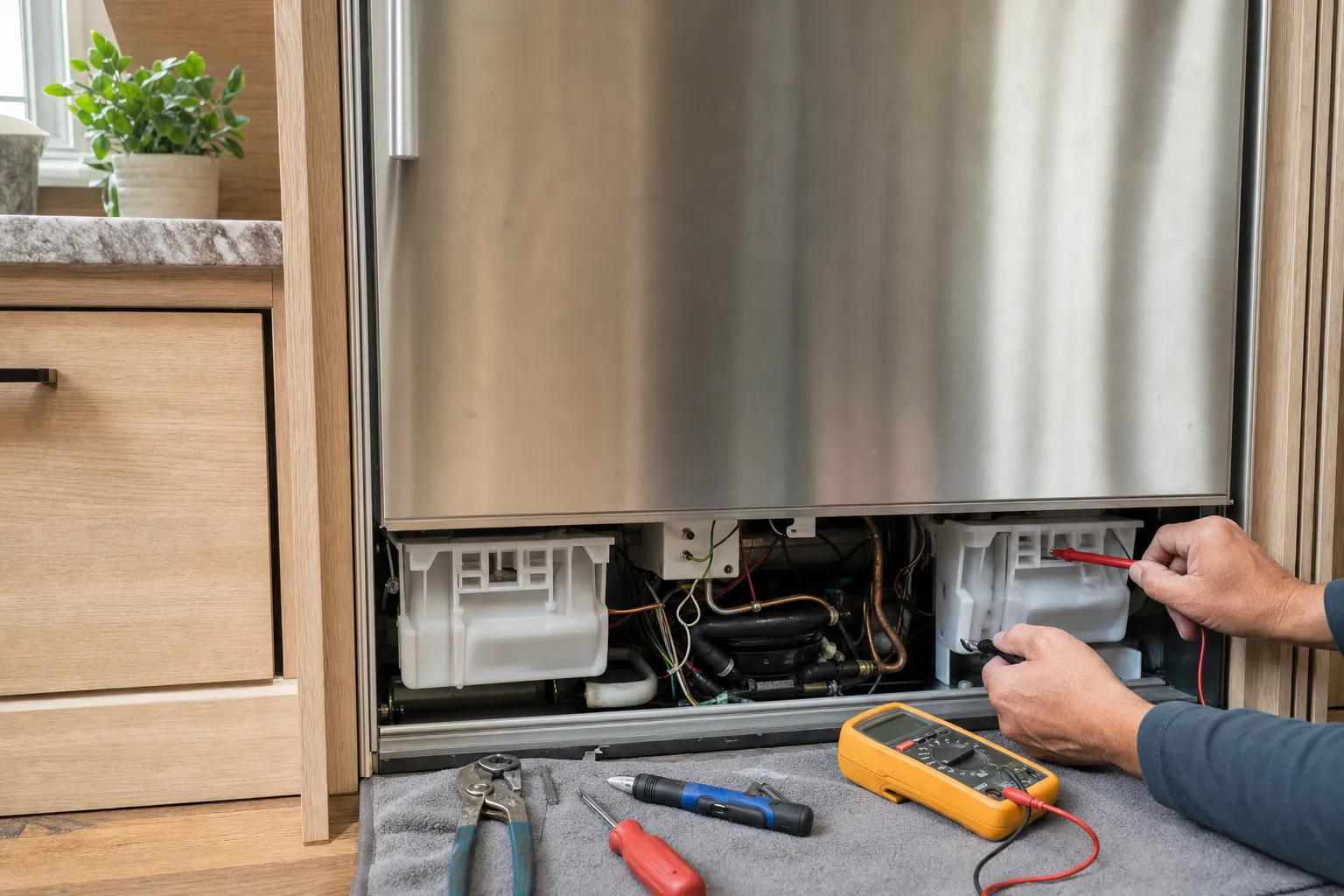
Loose, bent or marked
- Loose. A handle that rocks on its mounts has fixings working free. Securing them treats the symptom; the question is what made someone pull that hard.
- Bent. A bar knocked off line, or hauled on from one end, stays under strain once bent. We replace it rather than try to straighten it.
- Marked. Scratches and scuffs on stainless trim are cosmetic. Sub-Zero’s PRO guide asks for a stainless cleaner with no abrasive in it, on a soft cloth, only ever with the grain; a scouring pad across the grain leaves marks of its own.
Why the door matters here
A front that sticks, rubs its neighbour or has settled on a worn hinge takes more pull to open, and all of that pull goes through the handle mounts. So does a drawer badly seated on its slides. After the handle, we open every door and drawer and feel for drag.
Matching the handle
Sub-Zero’s current design guide lists a standard handle length for the PRO door, the refrigerator drawer and the freezer drawer. The door handle is the same length on both widths; the drawer handles are not, so a 36-inch part will not suit a 48-inch drawer. Stainless pro handles are a dealer option. Where a handle style is part of a Sub-Zero model number, the key marks it /PH or /P for a pro handle and /TH or /T for a tubular one.
Where this sits
Back to PRO SeriesPRO3650, PRO3650G, PRO4850, PRO4850G: the series this note belongs to.